Credit card advance
Look up and advance credit card receivables, and track your customers' advances and outstanding balances.
The Credit Card Receivables API lets the partner integrate the advance journey into their platform and streamline looking up and contracting the service.
Use Cases
The API covers the full advance journey and post-operation tracking. The main use cases are:
Lookup and simulation
- Look up a customer's available advance limit ("operation pool").
- Look up the schedule of card receivables available for advance.
- Filter/search receivables by due date, desired amount, payer (acquirer), and card scheme.
- Request quotes on the available receivables, including the automatic advance scenario.
- Look up the actions allowed for the customer at that moment, with the validations required to operate.
Contracting
- Contract the advance of credit card receivables, specifying the receivables and the disbursement account.
Tracking
- Look up the details of a contracted operation and the state of its receivables.
- Look up the customer's available/registered disbursement accounts.
- Look up the outstanding balance summary (chargebacks and pending payments).
- Receive notifications/webhooks about state changes of receivables, operations, and the outstanding balance summary.
Headquarters and Branch
Access to receivables and operations respects the corporate hierarchy identified by the customer's CNPJ:
- Logged in to the Headquarters → has access to everything: receivables and operations of the headquarters and all branches.
- Logged in to a Branch → has access only to its own branch.
In other words: the headquarters sees itself and the branches; the branch sees only itself.
Credit Card Receivables Advance
To use the full potential of this advance product, it is worth reviewing some concepts about the Brazilian Credit Card Receivables Advance Market.
Brazilian Credit Card Receivables Advance Market
Three entities work together so that the advance happens securely:
- Acquirer -> Credit card machine;
- Registrar -> Institution that registers all operations made with credit card receivables;
- Advance financing bank -> In this case, BTG Pactual Empresas.
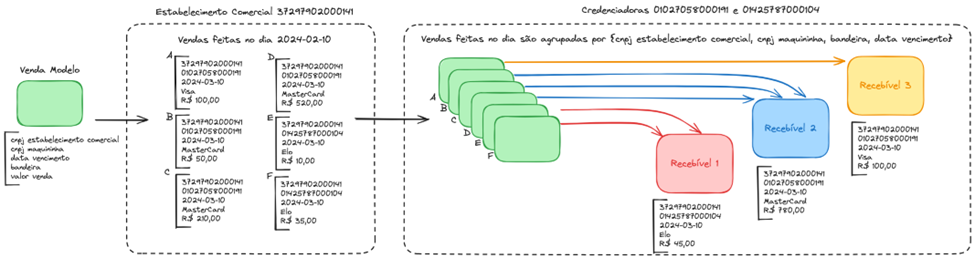
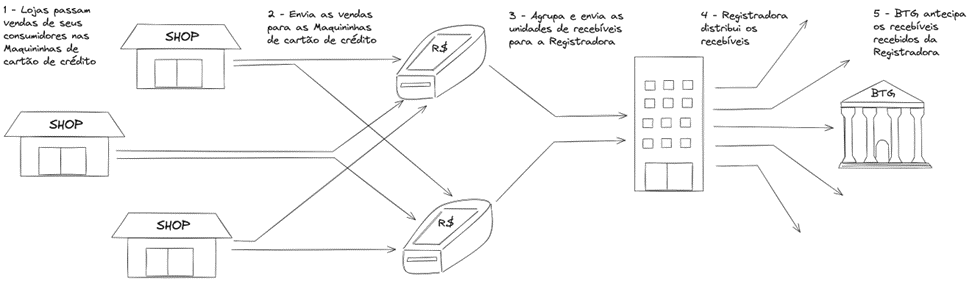
All sales processed through the credit card machine at merchants are sent to the acquirer, which in turn groups these sales by their due dates, the merchant's CNPJ, the acquirer's own CNPJ, and the card scheme, thereby generating the receivable units that can be advanced.
The acquirers send their receivable units to the registrar, which in turn passes these receivable units to all financial institutions that run operations with credit card receivables, and that is how the receivables reach BTG Pactual.
Tracking a credit card receivables advance
The advance journey comprises the following steps:
- The "Limit lookup" resource must be used to learn the advance amount available for the customer. You must not let the customer choose receivables whose sum of the "maturityAmount" field exceeds the available limit. If an operation is submitted exceeding this amount, it will be rejected and canceled.
- The "Receivables listing" resource must be used to learn the receivables available for the customer to advance at that moment; this list varies throughout the day, so it is important to refresh it before requesting the advance. The receivables list obtained is valid only on the day it is generated and must therefore be refreshed daily.
- The "Receivables advance" resource must be used to request a new operation by passing a list of receivables and a disbursement account. The customer must be the holder of this account and the receivable must have a due date between 3 business days and 365 calendar days. If the same receivable is submitted in 2 different operations, one of the operations will be refused and canceled, and the other will proceed. If the advance's disbursement or settlement accounts are not previously registered and active, the operation will be refused and canceled.
- Once all validations in steps 1 and 3 are complete, the requested receivables are sent for registration with the registrar. The registrar may register an amount lower than requested; see the "Receivables registration" section for details. The amount registered by the registrar is the reference amount for the advance, which we call "registeredAmount".
- With the registered amount, BTG starts the disbursement process and sends the registered amount minus the operation fees, which we call "disbursementAmount", to the customer's chosen disbursement account.
- With the "Operations lookup" resource, you can learn the states of the receivables and their amounts in real time. You can also subscribe to receive the available webhook events, which are sent every time a receivable or operation undergoes a state change.
- On the due date of the operation's receivables, the acquirer sends the registered amount to BTG Pactual, and the receivables are marked as "Settled", closing the advance journey. The acquirer may send an amount lower than the registered amount; see the "Receivables chargeback" section for details.
- The time window available for submitting advance requests may vary according to certain factors. We allow advance requests before 9 AM (provided receivables are available), but they only start the registration and disbursement flow after 9 AM. After 7 PM, all requested operations that have not yet been disbursed are automatically canceled.
-
Disbursement to an internal account:
- Requests can be made until 5 PM.
- Receipt occurs until 5:30 PM.
-
Disbursement to an external account:
- Requests can be made until 6:30 PM.
- Receipt occurs until 7 PM.
Sub-acquirers / Issuing Banks
Besides the journey in which the merchant advances its own receivables, there is a specific flow for sub-acquirers and issuing banks, in which the institution itself acts as the payer of the receivables.
Two resources are available in this flow:
- Quote — simulates and prices a list of receivables, returning the disbursement amount and the fees applied, without contracting the operation.
- Advance — actually contracts the operation, specifying the list of receivables and the disbursement account.
Important points of this flow:
- The identification of the operating institution is always derived from authentication, ensuring that each institution operates only on its own behalf.
- The quote is just a simulation and does not generate any operation; the advance, in turn, contracts the operation.
- Receivables with the nearest due date are prioritized when consuming the available limit.
Receivables registration
Because receivables are free to be traded by other financial institutions and by financial products other than BTG's advance product, the receivable's available amount may be partially or fully consumed at another institution or by another product. In this case, the registrar will not approve the full requested amount and will register the amount not yet operated by another institution or product up to that moment; we call this amount "registeredAmount". This registered amount becomes the reference for the disbursement amount of the advance journey.
Approved Acquirers
We operate with the following acquirers:
- CIELO S.A. 01027058000191
- REDECARD S/A 01425787000104
- GETNET 10440482000154
- STONE 16501555000157
- JUSTA 29959810000151
- SAFRA 58160789000128
- BEE2PAY 39744143000143
The acquirers returned for each customer are always a subset of the approved acquirers above, according to the receivables available for that customer at that moment.
Card schemes
We operate with the following card schemes:
- Visa
- Mastercard
- Elo
- AmericanExpress
- Hipercard
Receivables chargeback
In some cases, after a receivable is advanced, a sale that makes it up may be canceled by the consumer. When this happens, at the receivable's due date the acquirer will not send the amount of that sale to BTG. This canceled sale is called a chargeback. On the due date of a receivable that had a chargeback, there must be a balance in the customer's account to pay off the chargeback amount; otherwise, the customer will have an outstanding balance with BTG the next day and will be charged penalties and interest. Through the "Outstanding balance summary" resource, you can track a summary of these chargeback amounts and payments not yet sent by the acquirer, via the following fields:
-
"overdueReceivablesUnpaidAmount" -> Chargebacks of overdue receivables not yet paid off, plus their late-payment interest and penalties.
-
"dueTodayReceivablesUnpaidAmount" -> Chargebacks of receivables due today that do not yet have late-payment interest and penalties.
-
"receivablesOverdue" -> List of receivables not settled after their due dates.
You can also subscribe to receive the "receivables-credit-card.balance-summary" webhook event; this event is sent at 10 AM every day with the same fields as the "Outstanding balance summary" resource.
Available Resources
The Credit Card Advance API resources are available in the API Reference.